Data Management with Denodo Takes the GenAI Path: More Assistance, More Agent Readiness
In the enterprise sector, data management platforms are currently racing for greater relevance and accuracy in generative AI functions based on proprietary data. The Denodo Platform for logical data virtualization and management is no exception. The current release 9.2 and the further development of the AI SDK bring new AI-powered functions, both from the perspective of data analysis support and for agentive AI integrations. These functions are based on central metadata, semantic, and security management. In this post, we will present the most important innovations and show how companies can benefit from them.

Alexander Dolgopolskiy, Head of Data & AI, as of 08/21/2025
Logical Data Management and Analytics with Denodo 9.2 and Generative AI
Why the combination of curated data products and AI support marks the next step in data value creation.
As data-driven companies seek reliable results from the rapidly evolving world of artificial intelligence (AI), data management platforms are increasingly integrating production-ready Generative AI capabilities and agentic workflows into their proprietary data management.
Each platform focuses on different aspects. Denodo Logical Data Management is the focus, meaning the establishment of curated Data Products in a Business Data Layer. This combines structured data from diverse sources, from operational real-time data and data lakes to streaming data. The connection of these worlds with the new possibilities of Generative AI is one of the most exciting and dynamic areas of current enterprise IT progress.
In this blog post, we'll summarize the latest innovations and roadmap highlights from our partner Denodo – fresh from platform releases 9.2 and AI SDK 0.8, complemented by our own assessment of where things are headed.
Denodo Platform in Brief
If you stumbled upon this post by chance without having a clear picture of the Denodo Platform beforehand, we'll start with a brief introduction. For more details, we also recommend taking a look at our Denodo Partner Page as well as on the diagram below.
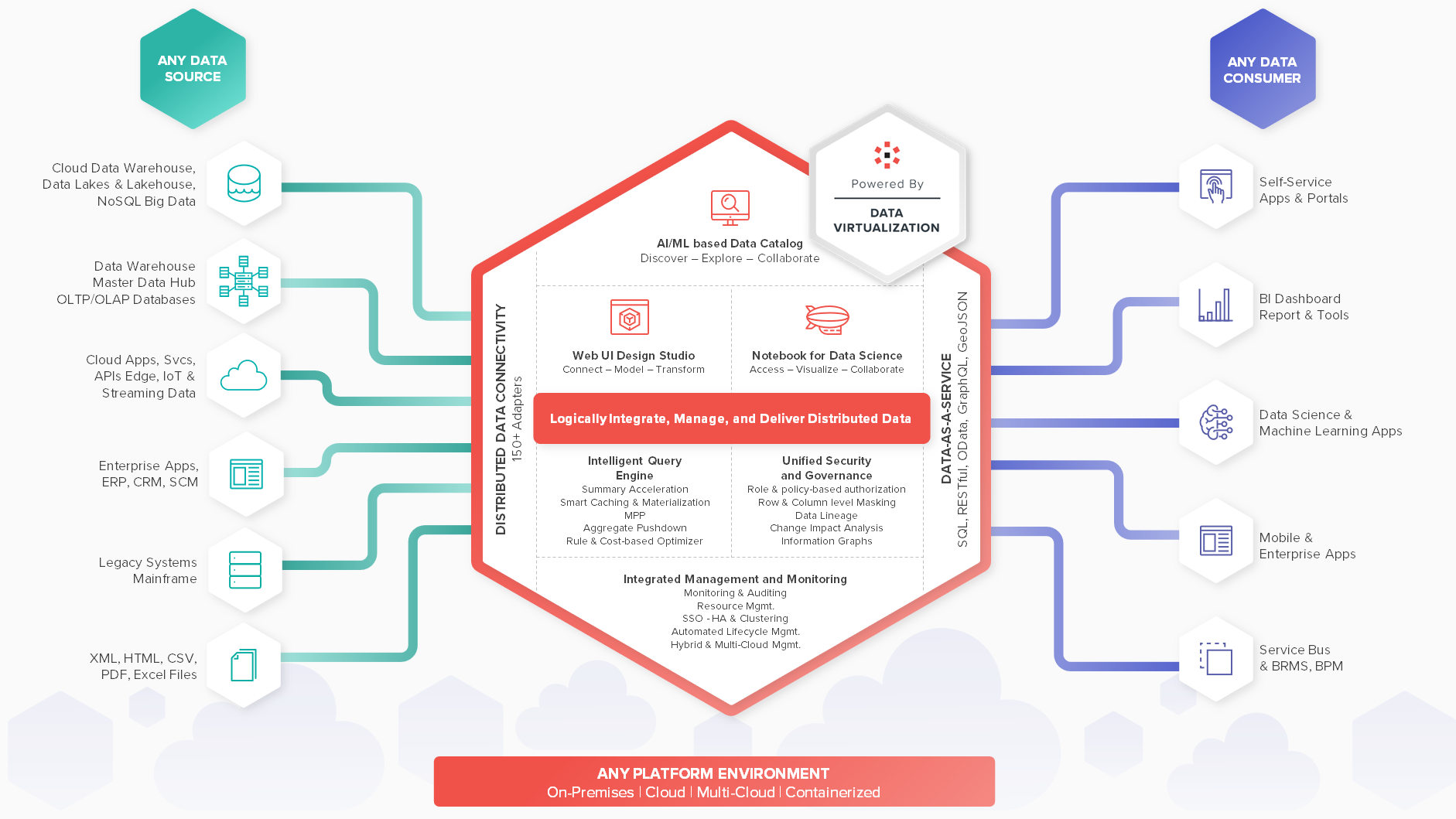
The Denodo Platform is fundamentally a solution for Logical Data Management and Data Virtualization. Simply put, it makes it possible to virtually connect data from the most diverse sources – from cloud databases and data lakes to classic enterprise applications and real-time streams – and display it in a consistent, semantic view.
The advantage: Companies can use data without physically moving it or implementing complex ETL processes. Instead, a flexible „Business Data Layer“ is created, from which data can be provided for a wide variety of use cases – from self-service BI to AI-powered analytics.
In summary:
Sure, there are use cases where ETL/ELT and persistent storage are the better choice – there's no one-size-fits-all solution. Denodo particularly excels where real-time data is paramount, supplemented by the ability to enrich it with cached or persistent data. But that's actually a topic in itself again.
Generative AI in the Corporate Context – and What Denodo Contributes
The trend is clear: companies no longer want to use generative AI only experimentally, but to integrate it firmly into business-critical applications. Three points are paramount: Enterprise-ready integration, highest relevance and accuracy of results and the Preparing for an Agent-Based Future, where AI independently takes on complex tasks and elevates productivity to a new level.
Denodo meets these requirements with two strong pillars:
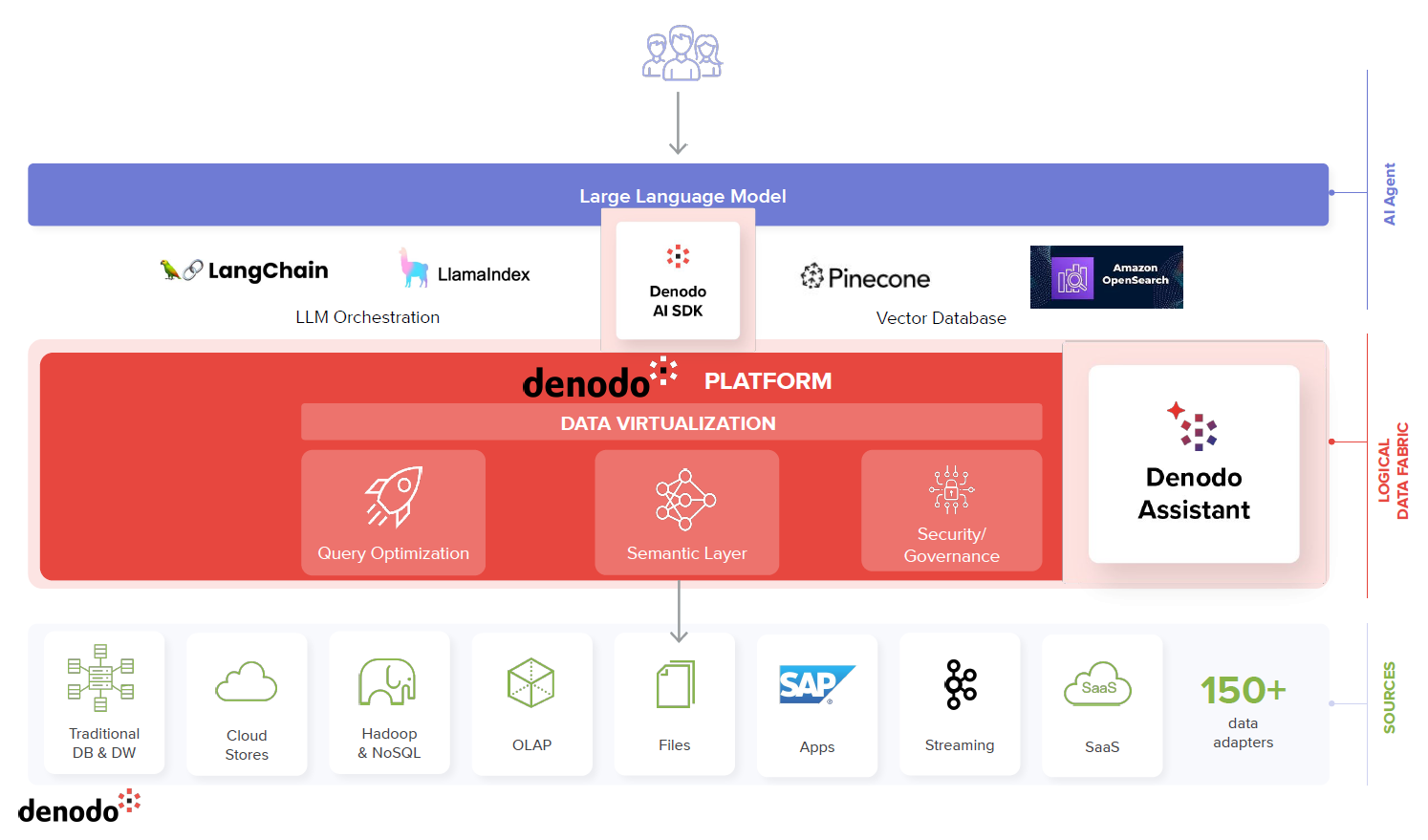
With both AI components, the operational systems integrated via Denodo, and the platform's central data management, an extensible ecosystem is created for companies that can be used equally by humans and AI agents.
Denodo Assistant and what's new in version 9.2
Join suggestions for Business Views
In addition to many already established features, version 9.2 brings a particularly practical innovation: Suggest Join Conditions. Often, business users want to create a business view from multiple tables, but they don't know exactly how to link them optimally. A typical example: Sales figures from a sales database are to be linked with customer information from the CRM system to create regional performance reports.
In this case, it is enough to add the desired tables via drag-and-drop and ask the wizard for a suggestion. Denodo will then analyze the existing relationships, dependencies, and metadata and provide several join variants with brief explanations. The user can then make an informed selection – without having to delve into technical details.
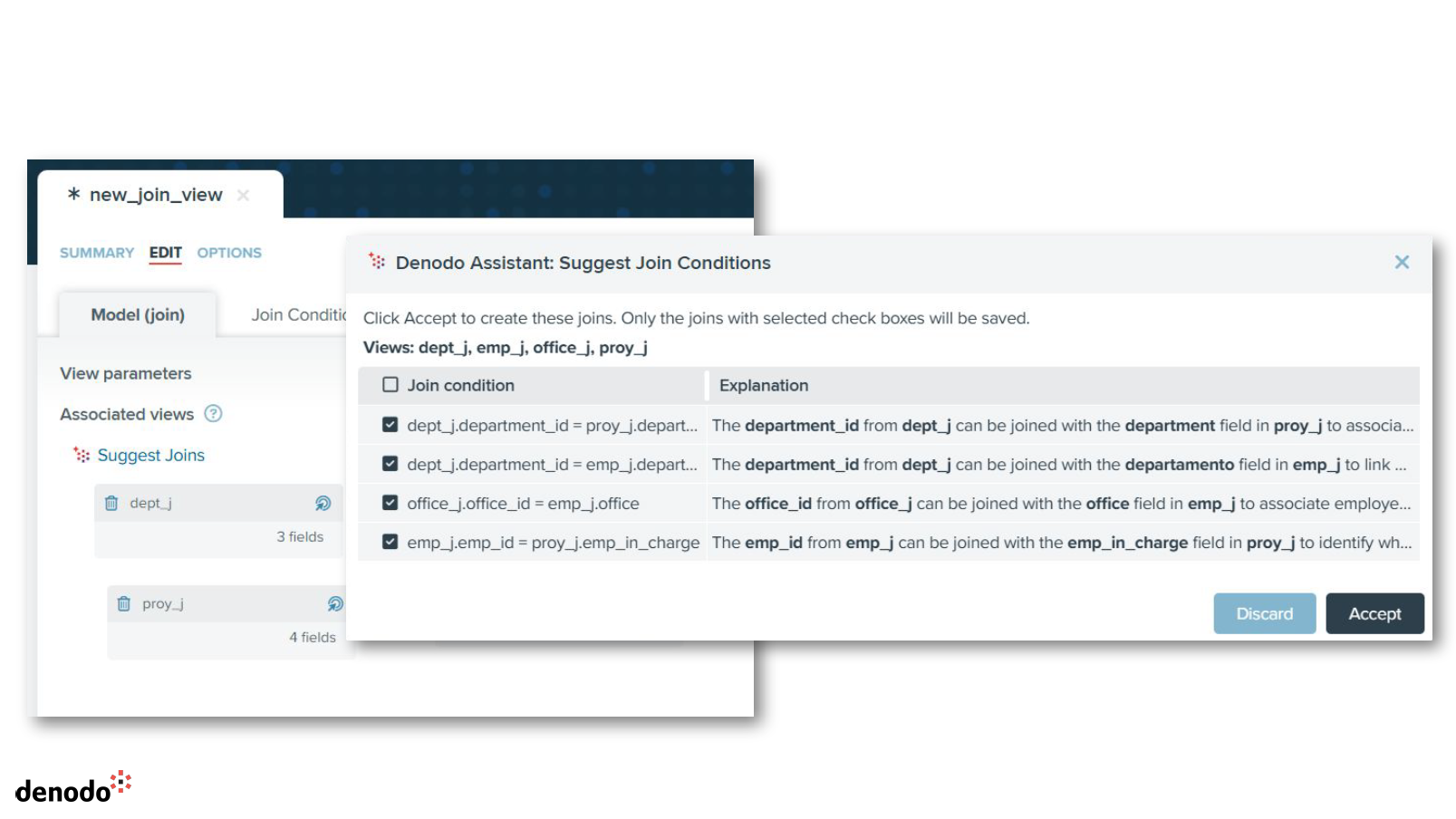
But even for Data Engineers with a solid understanding of the datasets, tables, and possible joins, the function is a real advantage. On the one hand, it saves time and significantly speeds up the creation of views. On the other hand, especially with large data schemas and complex data products, dependencies can be easily overlooked and errors can creep in. An attentive, knowledgeable co-pilot ensures more speed and, at the same time, greater accuracy here.
Custom Instructions in Denodo Assistant and AI SDK
New in version 9.2 is the ability to use the Assistant with Custom instructions to tax. This allows you to set, how the assistant generates metadata descriptions for views and data products and for whom it formulated. Instead of generic texts, the assistant can write domain-specifically, for example, with trade terms for retail or with KPIs and terminology common in one's own company. This increases the Contextual relevance and accuracy and reduces rework.
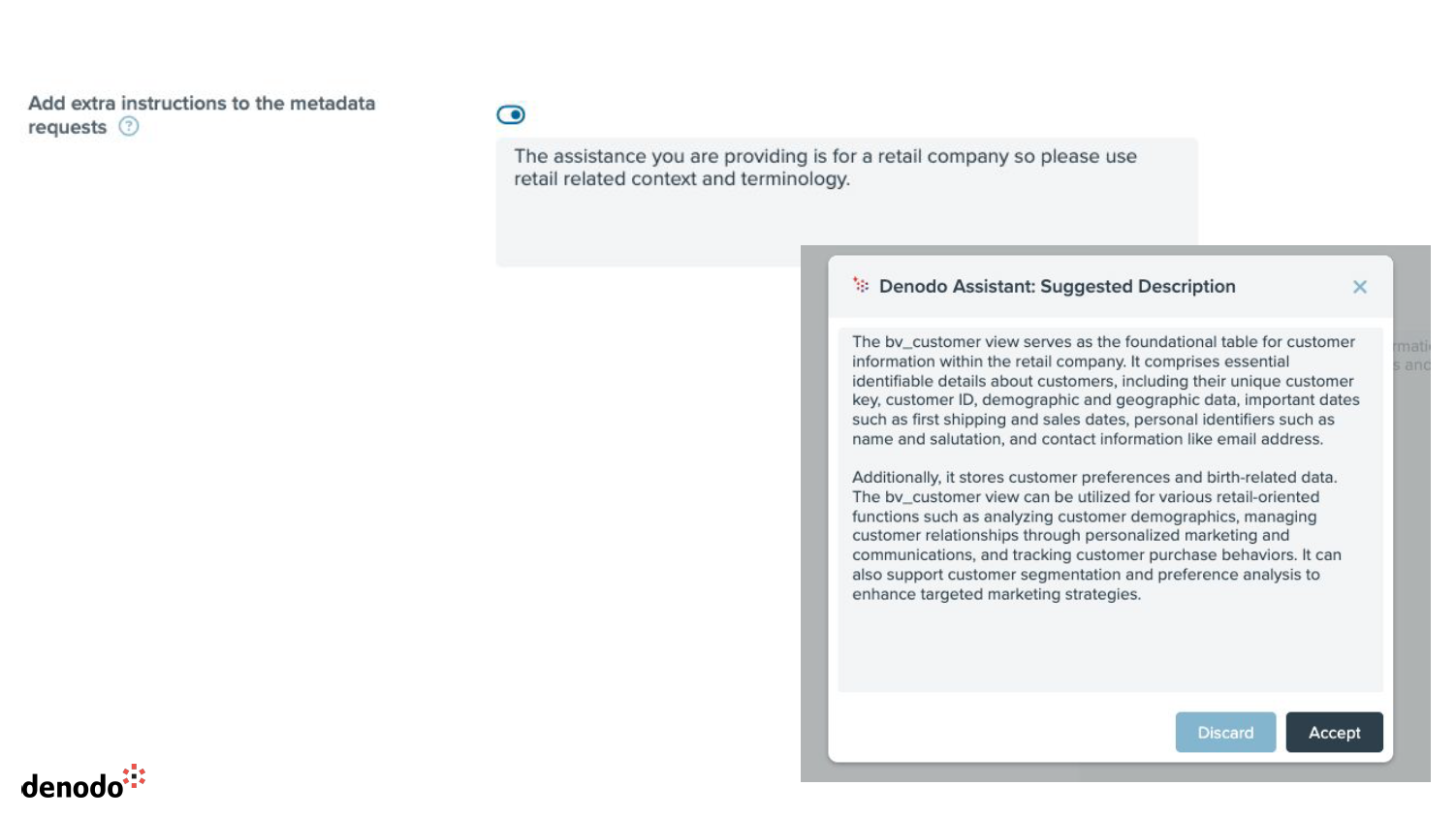
A simple example: „Describe views from the retail sector using the terms store, product category, and gross revenue, and target marketing readers. Write concisely, in complete sentences, in German.“ The assistant then generates more suitable descriptions for the catalog and data products.
The classification is important: Custom Instructions supplement Governance, sie replace No guidelines. They improve understandability and consistency in the catalog and make Data Products more tangible for business audiences.
The same principle applies to the AI SDK in the current expansion stage. Instructions can be found here for the query context deposited, optionally on Deployment Level or per user profile. This allows agent responses and query suggestions to be reliably aligned with company language and domain rules, without code changes everywhere.
Use LLM functions directly in VQL
With version 9.2, Denodo enhances its VQL query language with the capability to, LLM functions directly in data queries to embed. This allows Large Language Models to be not only used as a separate application but also seamlessly integrated into existing data products and pipelines.
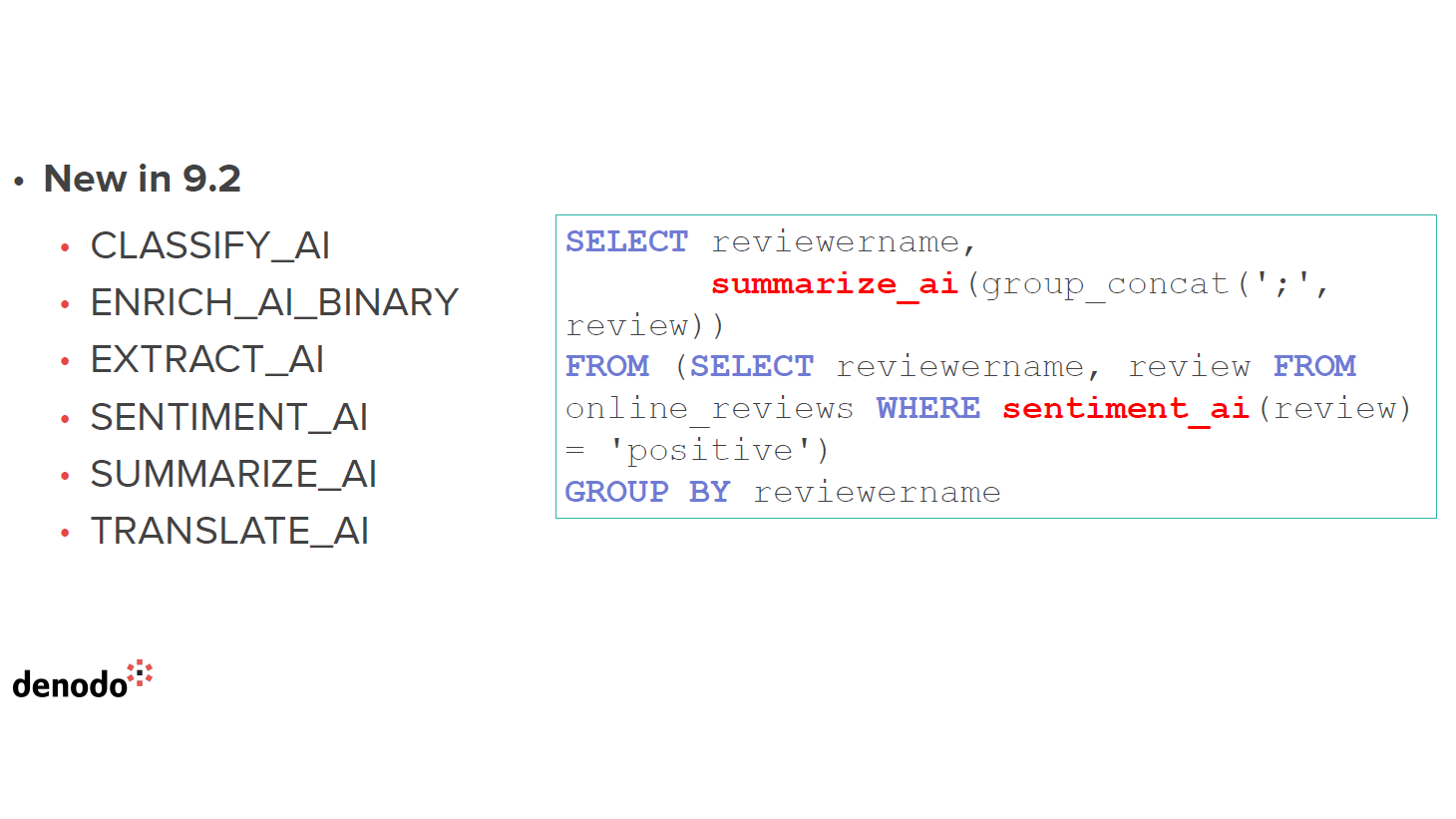
This opens up exciting scenarios: For example, a marketing team could analyze customer feedback data from various sources in real-time and immediately use the result with an automatic Sentiment Analysis enrich. Instead of running this analysis in a separate AI application, it is executed directly within the VQL query – the results are immediately available in the familiar analysis or reporting tool.
The advantage:
With this, Denodo takes the step from pure data provisioning to data-centric AI workflows, which run directly on the curated business data layer.
Denodo AI SDK – Bridging the Gap Between Data Management and Agentic AI
The Denodo AI SDK is the central building block for easily and securely integrating the curated data products built in Logical Data Management into individual AI applications and agent workflows. It acts as a bridge between the structured, governance-compliant data world of Denodo and the flexible, creative world of tailored Generative AI solutions.
This enables the development of chatbots, decision-support systems, or complex agent orchestrations that have direct access to reliable company data. The SDK handles the connection, provides a clean „grounding“ layer, and ensures that relevant data sources are used correctly, up-to-date, and securely, even for complex queries.
For companies, this means:
New in version 9.2: The AI SDK now offers a First, basic integration of an MCP server. This makes it even easier to connect agents and tools that support MCP with Denodo data.
MCP Support in Denodo AI SDK
The Model Context Protocol (MCP) is a young, open protocol that aims to make it easier for AI applications and agents to dynamically retrieve contextual information and data from external systems. Instead of programming interfaces individually, AI models can access tools, databases, or APIs in a standardized way via MCP – including metadata, authentication, and permissions.
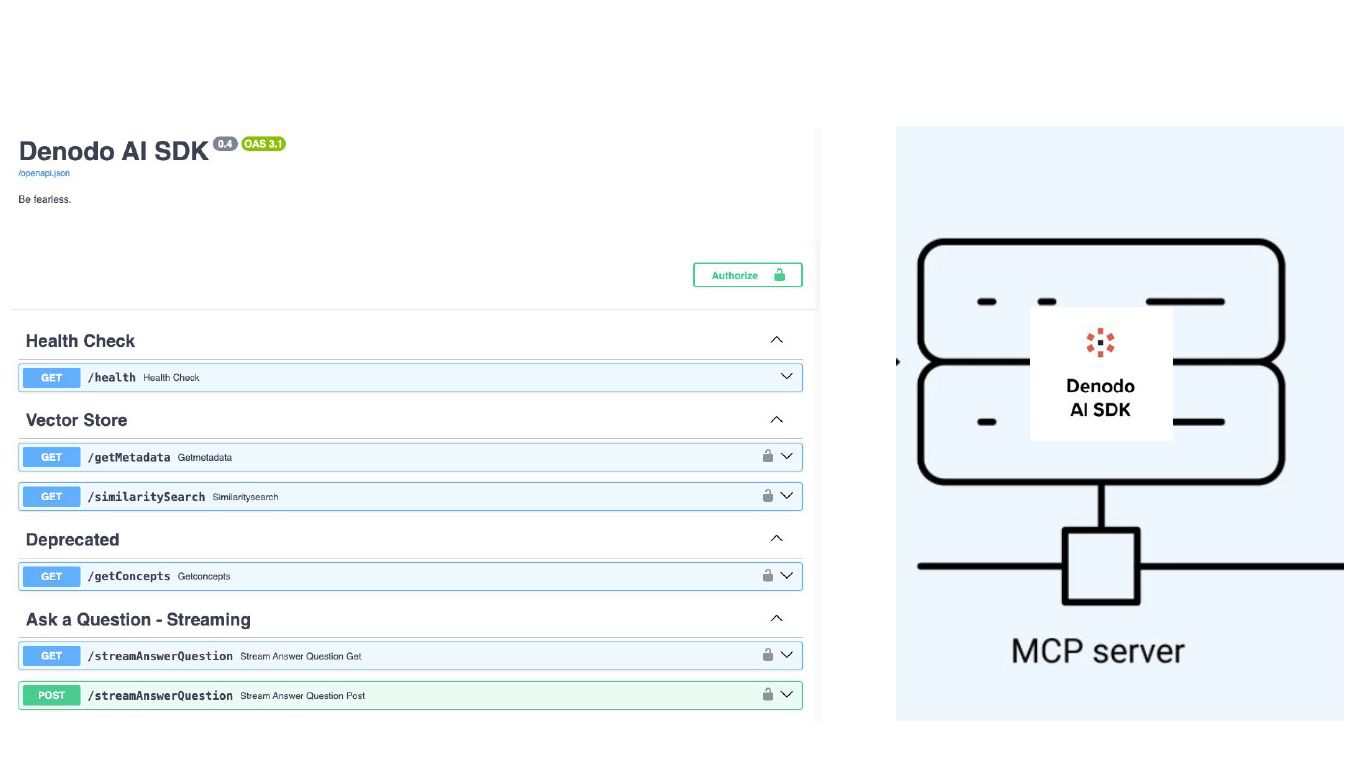
Denodo now offers a First, basic MCP server integration. The Basis-MCP-Server is included in AI SDK version 0.8 and is automatically installed along with the SDK. This allows MCP-enabled AI agents to directly access the centrally managed, curated data products in Denodo, benefiting from existing security and governance mechanisms.
The possible applications are diverse:
Important to note: Despite its potential, MCP is still in its early stages. Topics such as security, access control, and governance are still under development within the standard itself. Therefore, the Denodo-MCP integration is currently best suited for pilot projects and innovation workshops. Thus, it is (still) not ideal for security-critical production environments.
On the Way to Data Analyst Mode – Agentic Workflows in Denodo
The AI features embedded in Denodo today are already extremely useful – but so far, they are limited to so-called Single-Shot Interactions Aligned: A question is asked, the AI generates SQL, delivers a result, and the process is complete. This pattern resembles classic BI scenarios, except that query creation is automated.
Later this year, Denodo plans a move that goes significantly further: the Data Analyst Mode. In this mode, users should be able to ask complex analytical questions, such as: „What factors contributed to the decline in sales figures in a specific region?“ Instead of just generating a single query, the assistant, as part of a agent-based workflows independently perform various steps – comparable to the work of a human data analyst. This includes reviewing multiple datasets and sources, checking metadata, executing 10-20 (or more) queries, and deriving a well-founded result that answers the question.
We see this as part of a larger trend: Business-relevant AI workflows are increasingly being embedded directly into data management platforms.. This approach is logical, especially in the realm of data analysis – one of the most obvious use cases for proprietary corporate data. The lines between data management and BI applications are blurring, and platforms like Denodo, which with Logical Data Management can build directly on operational data sources, are particularly well-positioned for this.
From Potential to Reality
Denodo is a powerful self-service data management platform, but it is also a highly specialized tool and the central element of a data- and AI-driven ecosystem. To transform the full potential of the described functions into real business value, expertise, experience, and the right resources are needed. This is exactly where we come in.
If this sounds interesting to you, your next steps are simple:
Both are simple, non-binding steps that take little time but can provide a lot of tangible added value. And it's also fun, by the way.